Posthuman Ecologies by Rosi Braidotti Simone Bignall
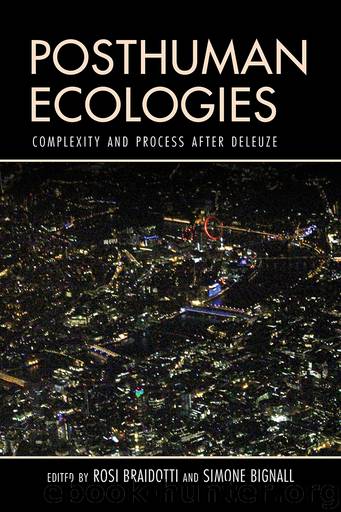
Author:Rosi Braidotti,Simone Bignall
Language: eng
Format: epub
ISBN: 9781786608246
Publisher: Book Network Int'l Limited trading as NBN International (NBNi)
Published: 2018-11-30T10:25:08+00:00
159Chapter 9
Indigeneity, Posthumanism and
Nomad Thought
Transforming Colonial Ecologies
Simone Bignall and Daryle Rigney
The Autochthon can hardly be distinguished from the stranger because the stranger becomes Autochthonous in the country of the other who is not, at the same time that the Autochthon becomes stranger to himself, his class, his nation, and his language. —Gilles Deleuze and Félix Guattari1
Are the ‘new Humanities’ inclusive of Indigenous perspectives, and do they acknowledge the specificity of Indigenous experiences of human being? On the one hand, posthumanism describes features also at the heart of internationally shared Indigenous conceptualisations of their humanity as being constituted in inextricable relations with the nonhuman world. Such philosophies include a refusal of anthropocentrism and human exceptionalism; a genealogical and constructivist account of identity; and an acknowledgement of species interdependence and consubstantial intersubjectivity in interactive ecologies shared by human and nonhuman beings. They convey an expressive and process-oriented ontology accompanied by an ecological understanding of the interconnected forces, including nonhuman agencies, operating formatively within a complex system; and an associated materialist and vitalist ethics of human responsibility, which registers an intimate and ontological connection of humanity with the ecological health of the environment that sustains life-forms and diversifies creative potential through rich networks of interconnectivity. These ‘more-than-human’ ways of knowing, being and acting have characterised Indigenous ontology, epistemology, axiology and ethology since time immemorial, and today they constitute a significant site of shared identification across the Indigenous world. And yet on the other hand, according to the terms of its emergence in the Western academy ‘after humanism’, Continental posthumanism appears to ignore the prior existence of Indigenous knowledge of this kind. In a solipsistic gesture 160long typical of Western imperialism, posthumanist theory at times risks the elision of Indigenous cultural and intellectual authority by remaining blind to the ancient presence and contemporary force of Indigenous concepts of human being. This exclusion allows Western philosophy to claim the ‘new Humanities’ as its current ‘discovery’ after modern humanism, but this apparently ‘new’ intellectual frontier in fact traces an ancient philosophical terrain already occupied by Indigenous epistemologies and associated modes of human experience.
By working together across our respective knowledge traditions as an Indigenous and a non-Indigenous scholar, we bring an Indigenous conceptualisation of ‘more-than-human’ being into alliance with notions of ‘posthumanity’ arising in Continental philosophy. Our aim in this chapter is to contribute to the ongoing task of intellectual decolonisation in postcolonial contexts.2 This is a crucial global duty, including in our home country Australia where Indigenous and settler peoples continue to struggle with and against the complex legacies of European cultural and territorial imperialism. Insofar as Western posthumanism has emerged strongly influenced by the philosophy of Deleuze and Guattari, we enquire about the role of their philosophy in the continuing elision of Indigenous ontologies in the disciplines comprising the new Humanities. While we value the emphasis they place upon Indigenous conceptual frameworks, experiences and examples, we remain troubled by the expression indigeneity receives as a consequence of the cluster of associations Deleuze and Guattari create, as well as by the structuring or constructive role indigeneity plays in this assemblage.
Download
This site does not store any files on its server. We only index and link to content provided by other sites. Please contact the content providers to delete copyright contents if any and email us, we'll remove relevant links or contents immediately.
| Anthropology | Archaeology |
| Philosophy | Politics & Government |
| Social Sciences | Sociology |
| Women's Studies |
The remains of the day by Kazuo Ishiguro(9004)
Tools of Titans by Timothy Ferriss(8403)
Giovanni's Room by James Baldwin(7352)
The Black Swan by Nassim Nicholas Taleb(7137)
Inner Engineering: A Yogi's Guide to Joy by Sadhguru(6799)
The Way of Zen by Alan W. Watts(6621)
The Power of Now: A Guide to Spiritual Enlightenment by Eckhart Tolle(5790)
Asking the Right Questions: A Guide to Critical Thinking by M. Neil Browne & Stuart M. Keeley(5779)
The Six Wives Of Henry VIII (WOMEN IN HISTORY) by Fraser Antonia(5519)
Astrophysics for People in a Hurry by Neil DeGrasse Tyson(5196)
Housekeeping by Marilynne Robinson(4455)
12 Rules for Life by Jordan B. Peterson(4312)
Ikigai by Héctor García & Francesc Miralles(4279)
Double Down (Diary of a Wimpy Kid Book 11) by Jeff Kinney(4278)
The Ethical Slut by Janet W. Hardy(4262)
Skin in the Game by Nassim Nicholas Taleb(4257)
The Art of Happiness by The Dalai Lama(4133)
Skin in the Game: Hidden Asymmetries in Daily Life by Nassim Nicholas Taleb(4012)
Walking by Henry David Thoreau(3968)
